
Introduction to AI Competitive Advantage Framework
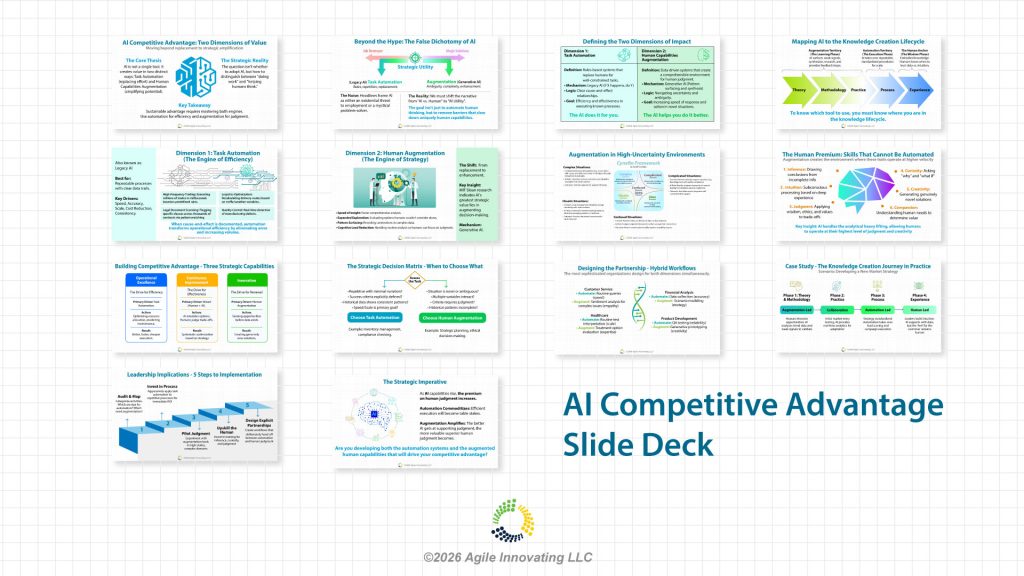
The AI competitive advantage framework provides a strategic lens for understanding how artificial intelligence creates value in two distinct dimensions: task automation and human capabilities augmentation. This visual guide breaks down the complete framework in 14 slides, making it easy to understand when to automate, when to augment, and how to design hybrid workflows that leverage both approaches strategically. For the comprehensive deep-dive with detailed case studies and implementation strategies, read the full AI competitive advantage article.
Slide 1: The Core Thesis – Two Dimensions of Value
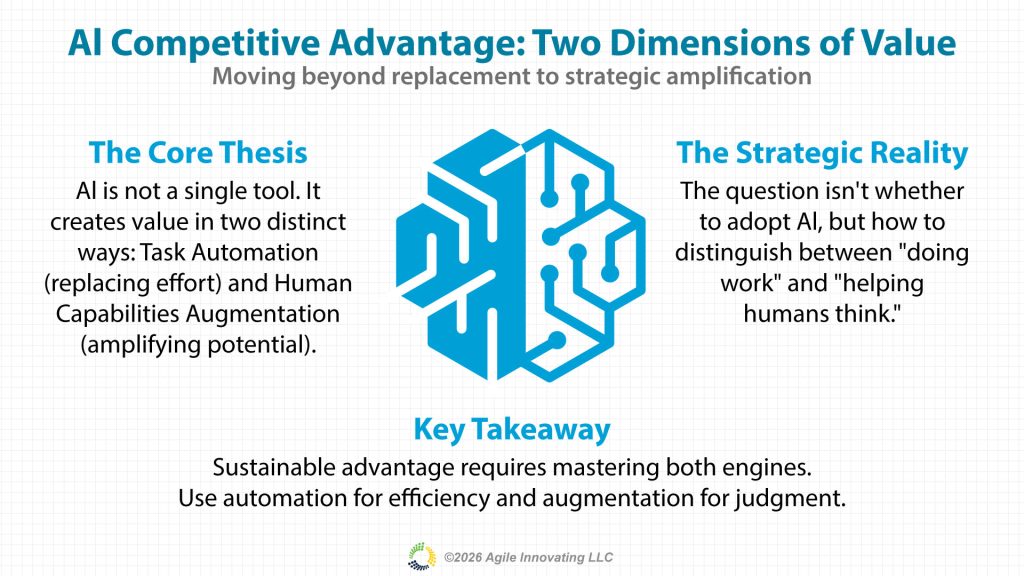
The AI competitive advantage framework begins with a fundamental insight: AI isn’t a single tool with one purpose. It creates value in two distinct ways that require entirely different strategic approaches. Task automation replaces human effort in well-constrained activities, while human capabilities augmentation amplifies potential by creating comprehensible environments for judgment. Organizations that master both dimensions build sustainable competitive advantages that competitors struggle to replicate.
Slide 2: Beyond the Hype – The False Dichotomy of AI
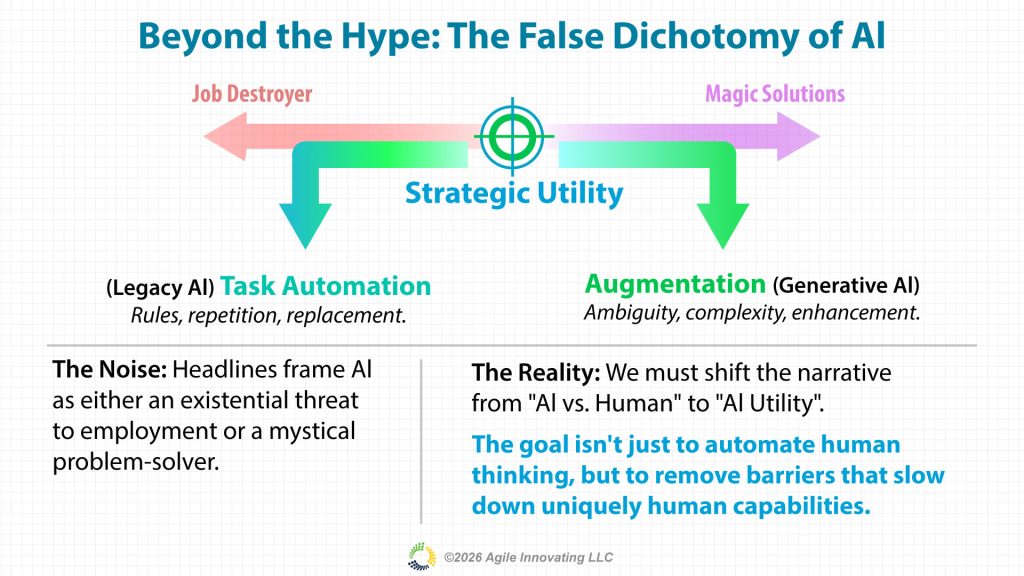
Headlines frame AI as either an existential employment threat or a mystical problem-solver, but this false dichotomy misses the strategic reality. The AI competitive advantage framework rejects the “AI versus Human” narrative in favor of “AI Utility”—understanding that different business contexts require different tools. Legacy AI handles rules, repetition, and replacement, while Generative AI navigates ambiguity, complexity, and enhancement. The goal isn’t to automate human thinking but to remove barriers that slow down uniquely human capabilities.
Slide 3: Defining the Two Dimensions of Impact
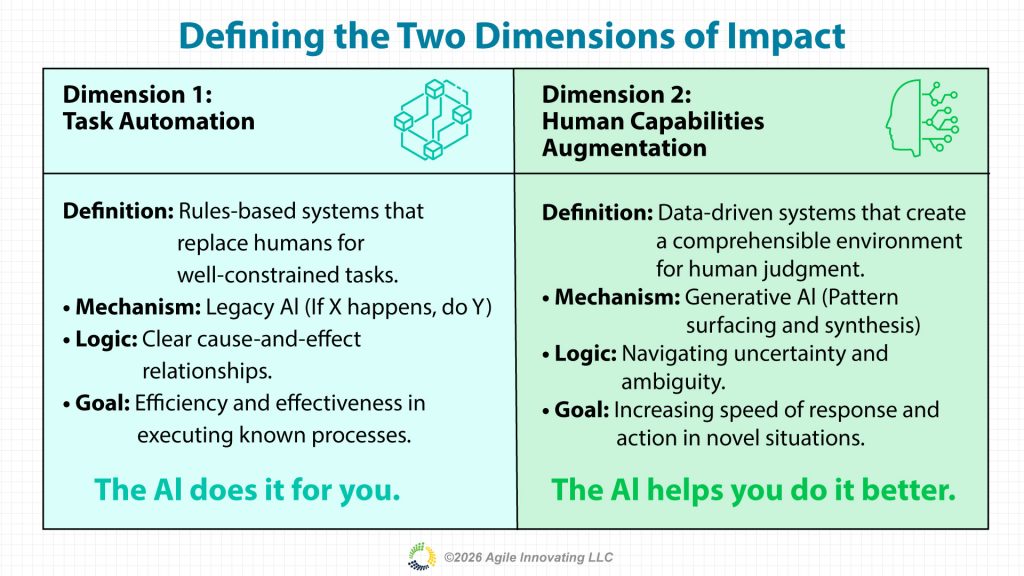
The AI competitive advantage framework distinguishes between two fundamentally different mechanisms of value creation. Task automation uses rules-based systems to replace humans for well-constrained tasks, operating on clear cause-and-effect relationships with efficiency as the primary goal. Human capabilities augmentation uses data-driven systems to create comprehensible environments for human judgment, operating through pattern surfacing and synthesis with the goal of increasing speed of response in novel situations. Understanding “the AI does it for you” versus “the AI helps you do it better” clarifies which tool to deploy when.
Slide 4: Mapping AI to the Knowledge Creation Lifecycle
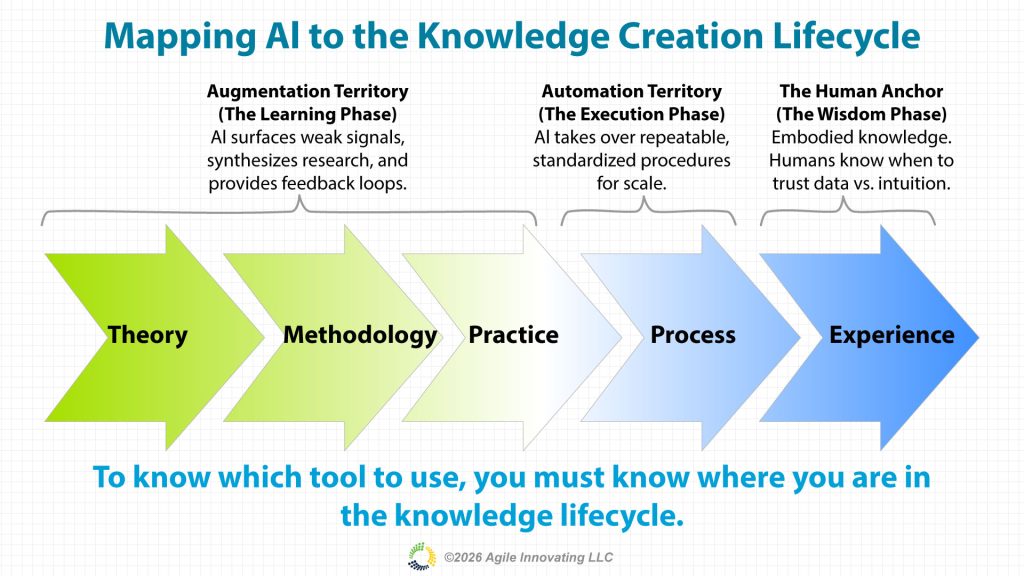
The AI competitive advantage framework maps to the knowledge creation lifecycle, revealing distinct territories where each dimension delivers maximum value. Augmentation dominates the learning phase—theory and methodology—where AI surfaces weak signals, synthesizes research, and provides feedback loops for exploration. Automation takes over in the execution phase—process and standardized procedures—where repeatable activities scale efficiently. The human anchor remains constant in the wisdom phase—experience and embodied knowledge—where humans retain the ability to know when to trust data versus intuition.
Slide 5: Dimension 1 – Task Automation (The Engine of Efficiency)
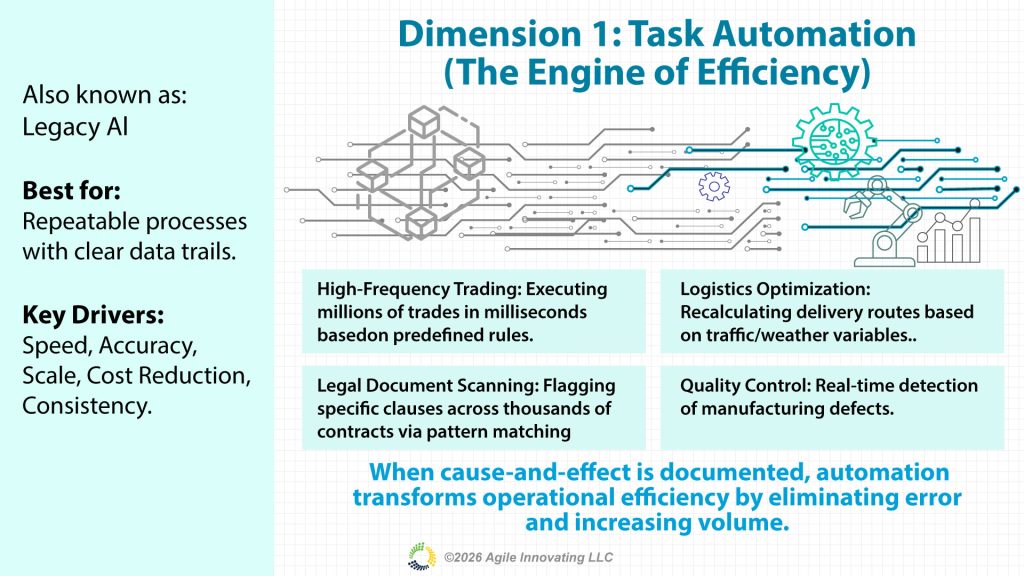
Task automation, also known as Legacy AI, excels at repeatable processes with clear data trails. The AI competitive advantage framework identifies key drivers: speed, accuracy, scale, cost reduction, and consistency. High-frequency trading executes millions of trades in milliseconds based on predefined rules. Logistics optimization recalculates delivery routes based on traffic and weather variables in real-time. Legal document scanning flags specific clauses across thousands of contracts via pattern matching. Quality control detects manufacturing defects instantly. When cause-and-effect is documented, automation transforms operational efficiency by eliminating error and increasing volume.
Slide 6: Dimension 2 – Human Augmentation (The Engine of Strategy)
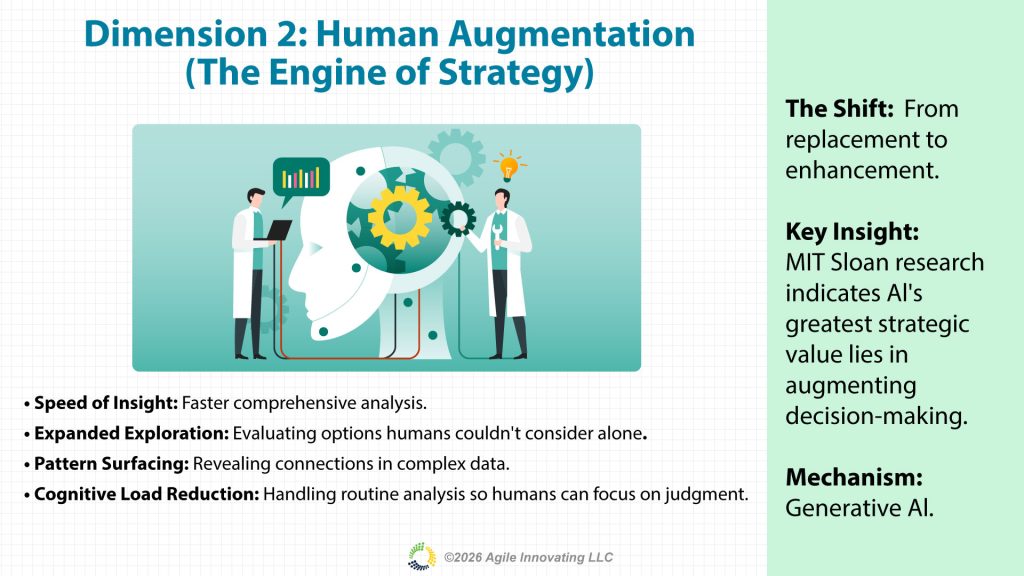
Human augmentation represents the strategic shift from replacement to enhancement. The AI competitive advantage framework reveals MIT Sloan research indicating AI’s greatest strategic value lies in augmenting decision-making, not automating tasks. Generative AI provides speed of insight through faster comprehensive analysis, expanded exploration by evaluating options humans couldn’t consider alone, pattern surfacing that reveals connections in complex data, and cognitive load reduction by handling routine analysis so humans can focus on judgment. The mechanism is distinctly different from automation—it creates the conditions for superior human thinking.
Slide 7: Augmentation in High-Uncertainty Environments
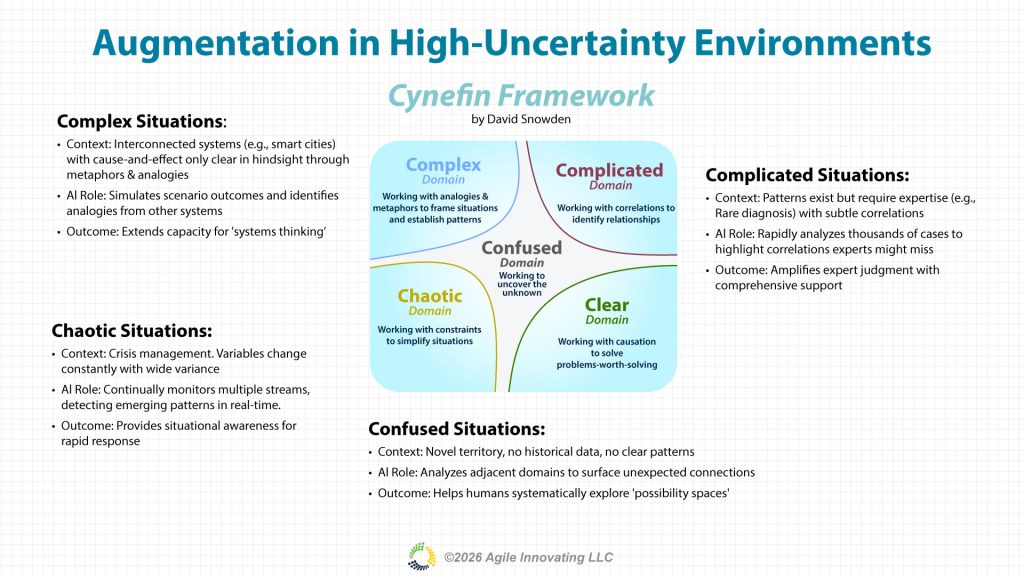
The AI competitive advantage framework leverages the Cynefin Framework by David Snowden to map augmentation value across different uncertainty contexts. In complex situations like smart cities, AI simulates scenario outcomes and identifies analogies to extend capacity for systems thinking. In complicated situations like rare diagnosis, AI rapidly analyzes thousands of cases to highlight correlations experts might miss, amplifying expert judgment with comprehensive support. In chaotic situations like crisis management, AI continually monitors multiple streams to detect emerging patterns in real-time, providing situational awareness for rapid response. In confused situations with novel territory, AI analyzes adjacent domains to surface unexpected connections, helping humans systematically explore possibility spaces.
Slide 8: The Human Premium – Skills That Cannot Be Automated
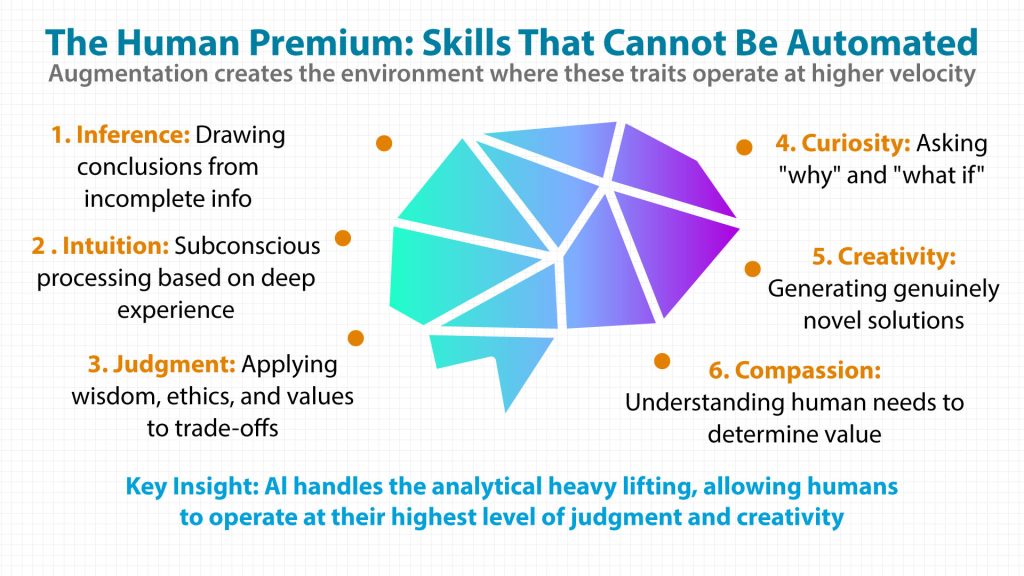
The AI competitive advantage framework identifies six irreplaceable human capabilities that increase in value as AI capabilities rise. Inference draws conclusions from incomplete information. Intuition relies on subconscious processing based on deep experience. Judgment applies wisdom, ethics, and values to trade-offs. Curiosity asks “why” and “what if” questions that reframe problems. Creativity generates genuinely novel solutions beyond pattern recombination. Compassion understands human needs to determine value in context. AI handles the analytical heavy lifting, allowing humans to operate at their highest level of judgment and creativity—this is where sustainable competitive advantage lives.
Slide 9: Building Competitive Advantage – Three Strategic Capabilities
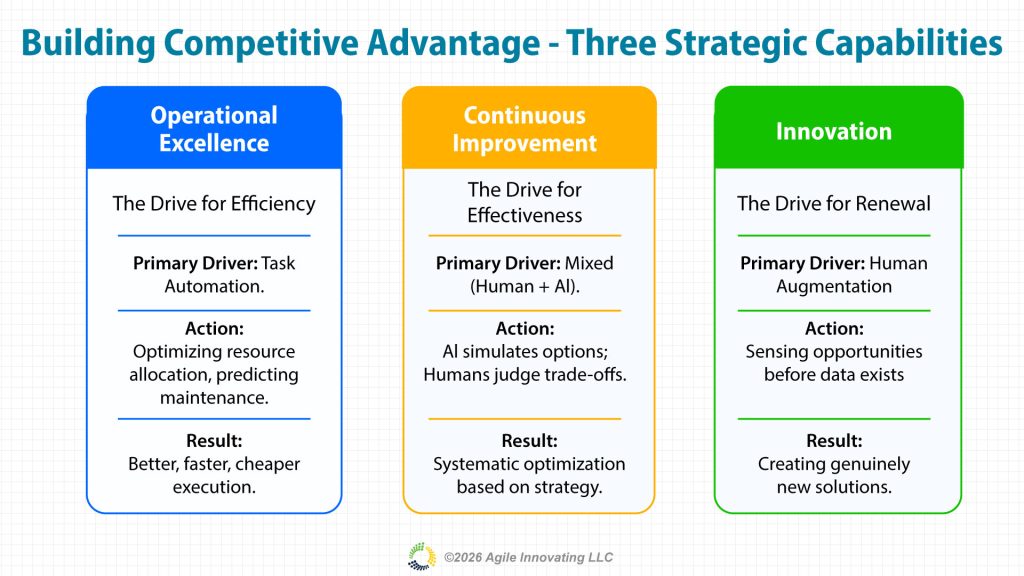
The AI competitive advantage framework identifies three distinct strategic capabilities, each with a different primary driver. Operational excellence—the drive for efficiency—relies primarily on task automation to optimize resource allocation and predict maintenance, resulting in better, faster, cheaper execution. Continuous improvement—the drive for effectiveness—uses a mixed approach where AI simulates options and humans judge trade-offs, producing systematic optimization based on strategy. Innovation—the drive for renewal—depends primarily on human augmentation to sense opportunities before data exists, creating genuinely new solutions that competitors haven’t imagined.
Slide 10: The Strategic Decision Matrix – When to Choose What
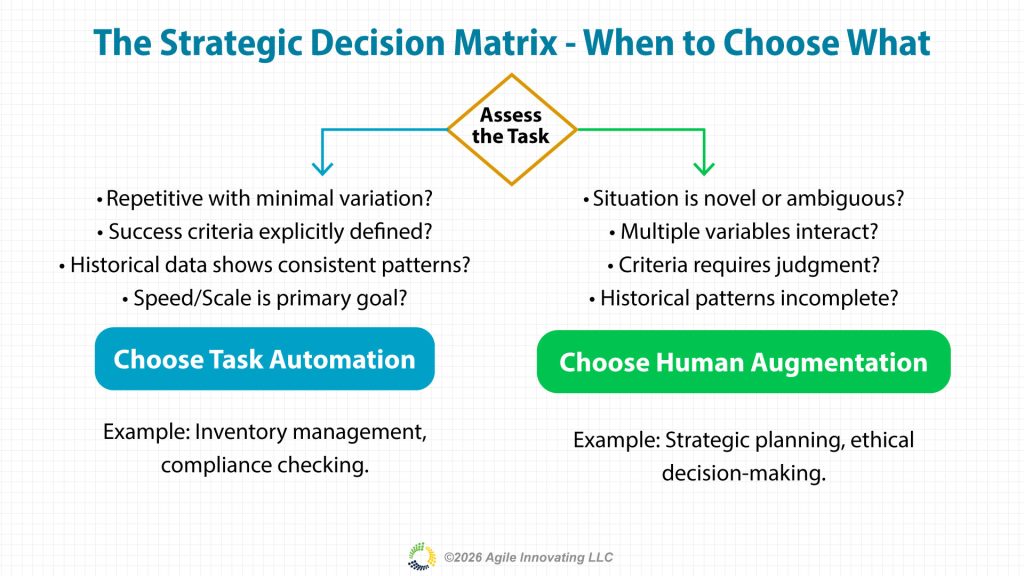
The AI competitive advantage framework provides a diagnostic decision matrix. Choose task automation when tasks are repetitive with minimal variation, success criteria are explicitly defined, historical data shows consistent patterns, and speed or scale is the primary goal—examples include inventory management and compliance checking. Choose human augmentation when situations are novel or ambiguous, multiple variables interact unpredictably, criteria require judgment calls, and historical patterns are incomplete—examples include strategic planning and ethical decision-making. This assessment determines which dimension creates maximum strategic value for specific business contexts.
Slide 11: Designing the Partnership – Hybrid Workflows
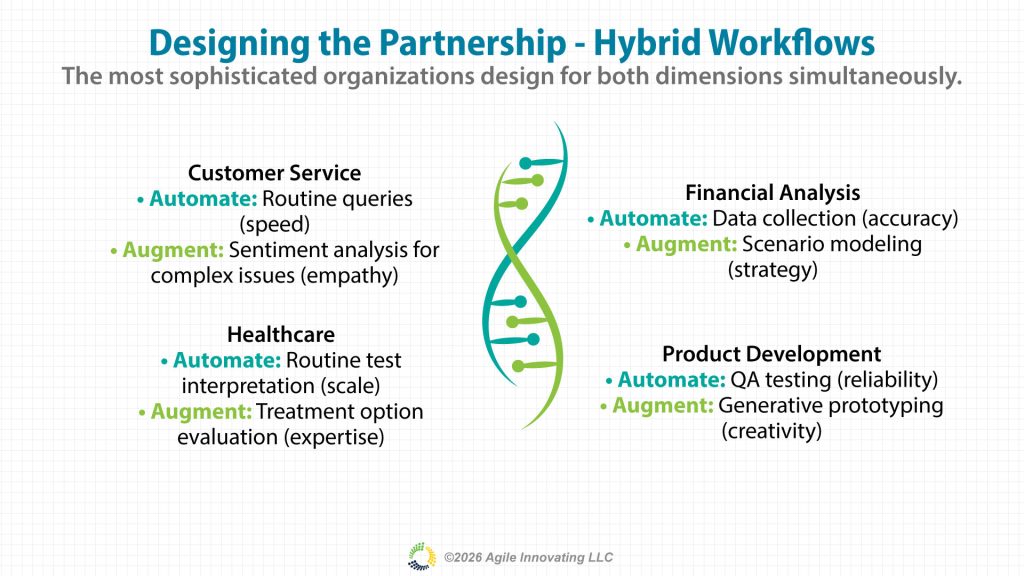
The AI competitive advantage framework recognizes that sophisticated organizations design for both dimensions simultaneously rather than choosing one or the other. In customer service, automate routine queries for speed while augmenting sentiment analysis for complex issues requiring empathy. In healthcare, automate routine test interpretation for scale while augmenting treatment option evaluation for expertise. In financial analysis, automate data collection for accuracy while augmenting scenario modeling for strategy. In product development, automate QA testing for reliability while augmenting generative prototyping for creativity. The DNA helix visual represents intertwined capabilities working in concert.
Slide 12: Case Study – Knowledge Creation Journey in Practice
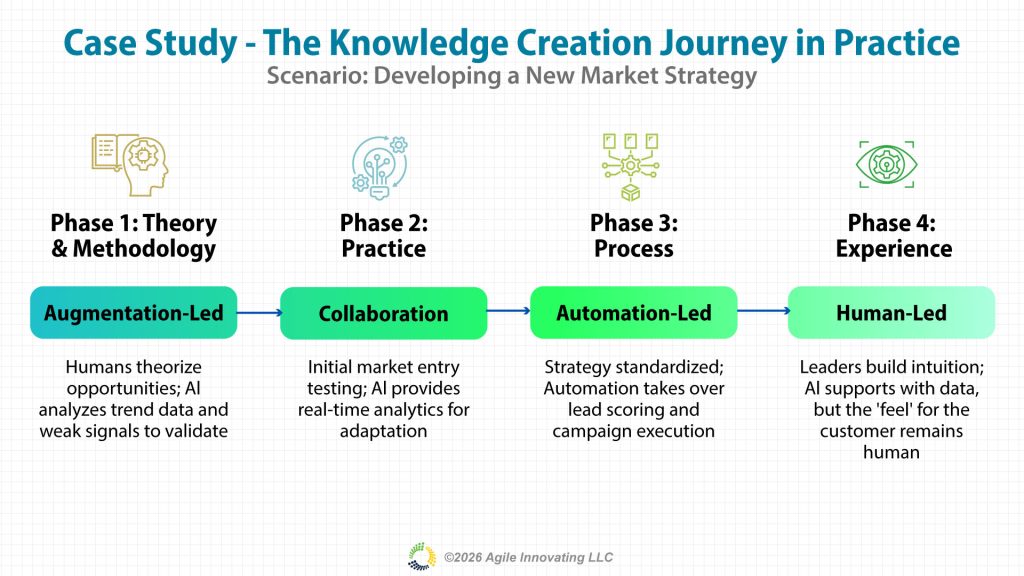
The AI competitive advantage framework comes to life through a practical scenario: developing a new market strategy. Phase 1 (Theory & Methodology) uses augmentation-led approaches where humans theorize opportunities while AI analyzes trend data and weak signals to validate hypotheses. Phase 2 (Practice) requires collaboration where initial market entry testing combines AI’s real-time analytics with human adaptation. Phase 3 (Process) shifts to automation-led execution as the strategy becomes standardized—automation takes over lead scoring and campaign execution at scale. Phase 4 (Experience) returns to human-led judgment where leaders build intuition and AI supports with data, but the “feel” for the customer remains distinctly human.
Slide 13: Leadership Implications – 5 Steps to Implementation
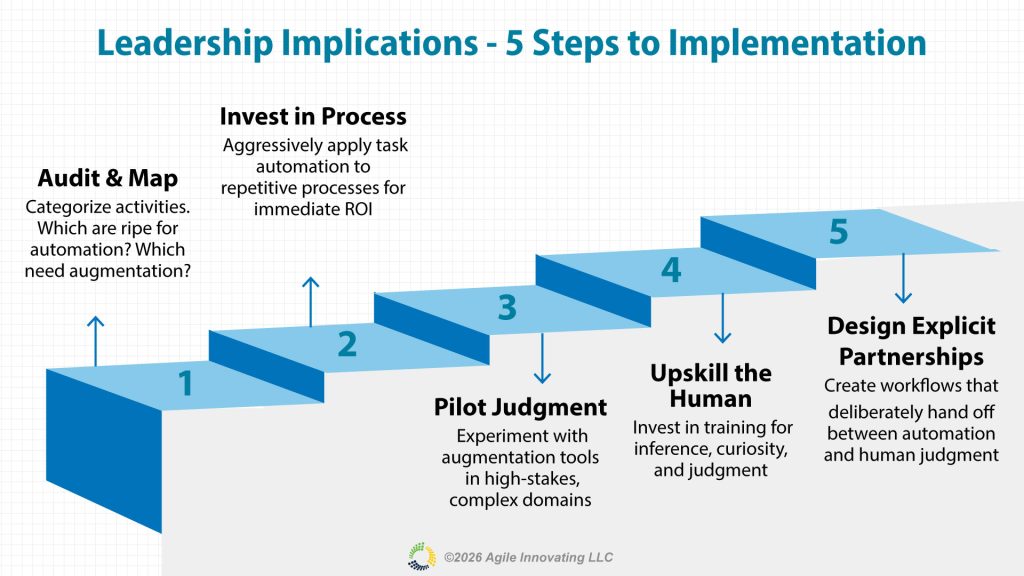
The AI competitive advantage framework translates to five actionable leadership steps. First, audit and map by categorizing activities to determine which are ripe for automation and which need augmentation. Second, invest in process by aggressively applying task automation to repetitive processes for immediate ROI. Third, pilot judgment by experimenting with augmentation tools in high-stakes, complex domains where strategic decisions matter most. Fourth, up-skill the human capability by investing in training for inference, curiosity, and judgment—the capabilities that create premium value as AI capabilities rise. Fifth, design explicit partnerships by creating workflows that deliberately hand off between automation efficiency and human judgment, optimizing for both dimensions simultaneously.
Slide 14: The Strategic Imperative
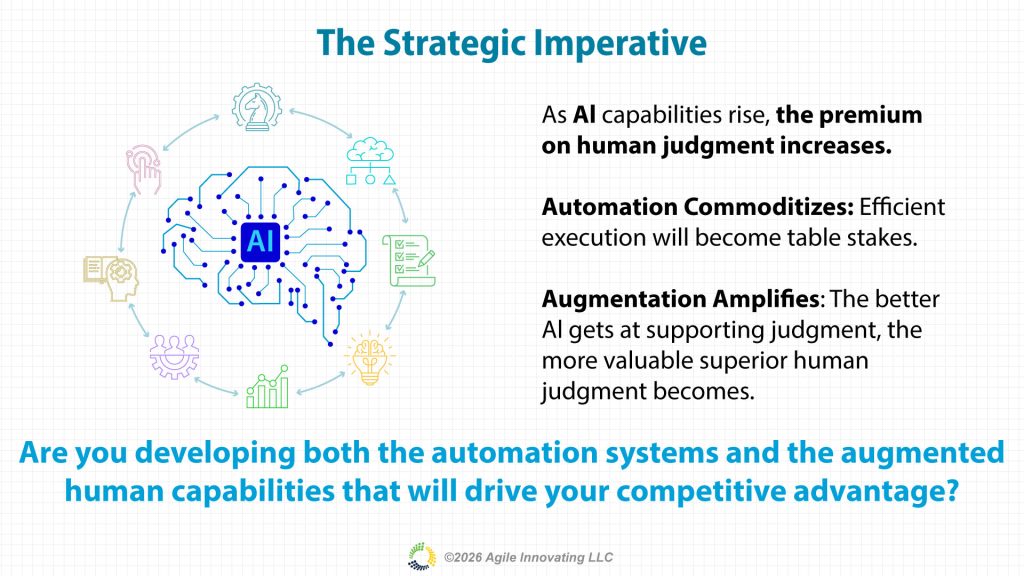
The AI competitive advantage framework concludes with a counterintuitive insight: as AI capabilities rise, the premium on human judgment increases. Automation commoditizes—efficient execution becomes table stakes that everyone can access equally. Augmentation amplifies—the better AI gets at supporting judgment, the more valuable superior human judgment becomes. Organizations developing both the automation systems AND the augmented human capabilities simultaneously will drive sustainable competitive advantage. Those optimizing for only one dimension will find themselves either inefficient or undifferentiated.
Next Steps
This visual framework provides the strategic foundation for understanding how AI creates competitive advantage through two distinct dimensions. For detailed implementation strategies, real-world case studies from Nestlé and Mattel, and comprehensive guidance on building both automation systems and augmented capabilities, explore the complete AI competitive advantage article 🔗.
The question isn’t whether to adopt AI—it’s which dimension you’re currently underinvesting in, and how to design the hybrid workflows that leverage both strategically.
© 2026 Axiom™ LLC | Kevin Fee