
Business performance improvement accelerates when organizations eliminate the Speed Killers that destroy momentum and prevent sustained competitive advantage. Every business leader faces the same fundamental challenge: how do you not just get ahead, but stay ahead when markets change faster than strategic plans can keep up? The answer to sustainable business performance improvement isn’t found in pushing harder on the accelerator. It’s found in releasing the brakes — eliminating three Speed Killers that systematically drain momentum before you can build it.
This reality puts every business into a constant, never-ending race for competitive advantage. But here’s what makes this race different: there’s no finish line, only the next lap. And you can bet there’s always another competitor right on your heels. The real question becomes: how do you build the stamina to keep outperforming everyone else when the race never ends? The answer is Compounding Momentum — what happens when systematic Speed Killer neutralization allows gains to accumulate exponentially instead of being destroyed by recurring losses.
Watch: Introduction to the Business Performance Acceleration Framework
📄 Read the Full Video Transcript (click to expand)
All right, today we’re jumping into a really powerful framework from agile innovating that’s all about cranking up your business’s velocity. We’re going to talk about how to build a competitive advantage that actually lasts by getting faster at well everything that really counts. Let’s get into it.
So, let’s just start with the big question, right? The one that every single leader is wrestling with. In a market that’s changing so fast it can make your head spin. How do you not just get ahead, but actually stay ahead? You know, it’s not about one hit product or some lucky break. It’s about building an engine that just keeps on improving day in and day out.
In this reality, it puts every single business out there into a constant, never-ending race for an advantage. But here’s the catch. In this race, there’s no finish line. There’s only the next lap. And you can bet there’s always another competitor right on your heels. So, the real question is, how do you build the stamina to just keep outperforming everyone else? And that right there, that’s the core challenge.
It is a relentless, non-stop pressure to get better. If you’re not getting fast, if you’re not getting smarter, you have to assume your competition is. And this isn’t just for scrappy startups either. Even the big established players can get knocked off their perch overnight. You know the real enemy here? It’s complacency.
So to win this race, agile innovating gives us a really key metric to focus on. Business velocity. Now listen, here’s the big idea. It’s not just about how good you are today or how different your product is right now. It’s all about the speed at which you’re getting better. Think of it like your company’s acceleration. How fast are you actually learning, adapting, and creating new value for your customers?
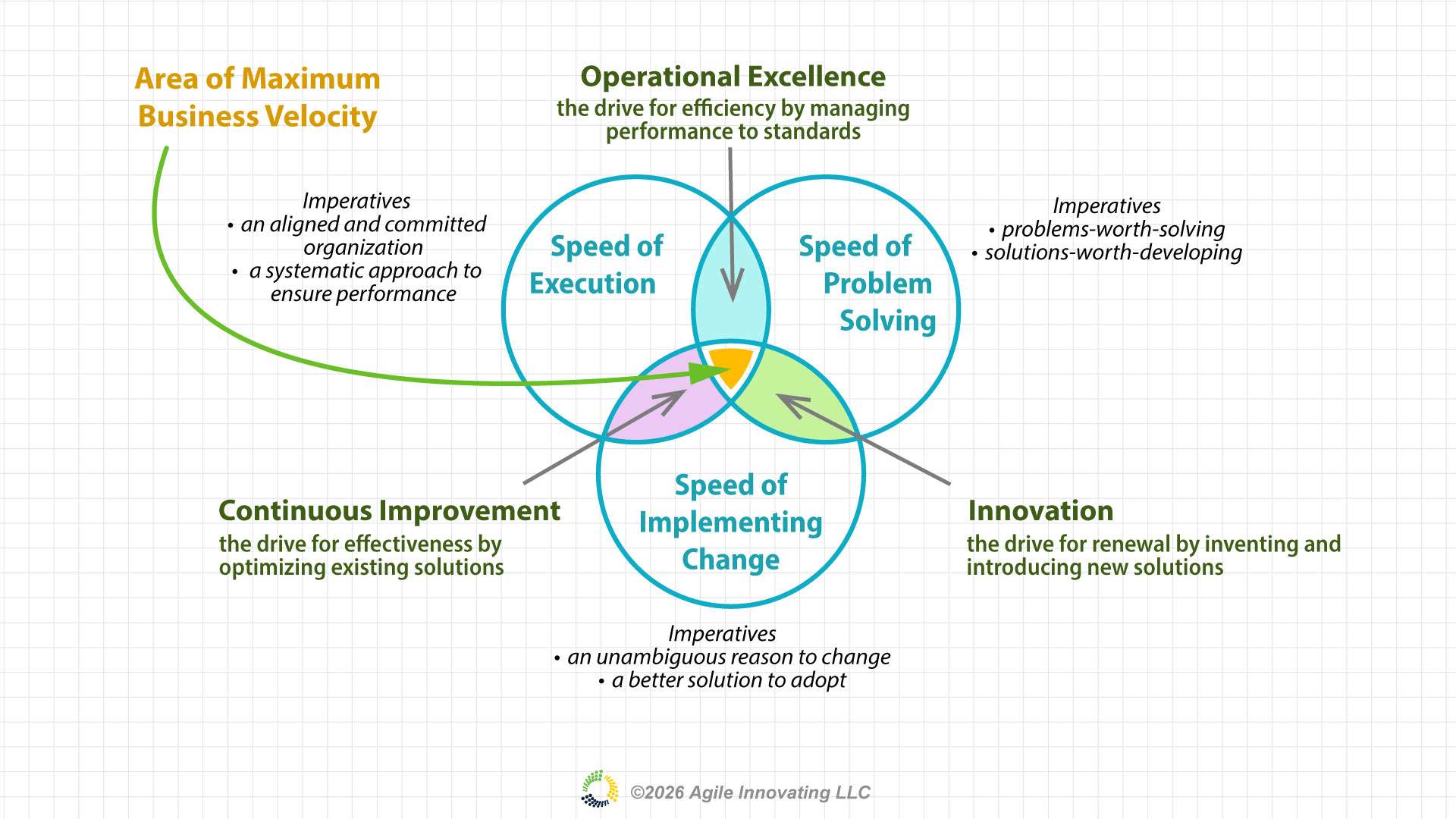
All right, so let’s really dig into this idea. What exactly is this engine of growth made of? How do you even measure it? And you know, most importantly, how do you make it go faster? So, this diagram here really breaks it all down. Business velocity is made up of three interconnected speeds.
First, you’ve got your speed of execution. That’s your day-to-day, right? How efficiently you get things done. Second is the speed of problem solving, which is really your innovation engine. And third is the speed of implementing change. How fast you can adapt and improve. Now, that sweet spot in the middle, that’s maximum business velocity. That’s where you hit when all three of these are firing on all cylinders.
Okay, but why all this talk about speed? Why does it matter so much? Well, because cranking up your business velocity directly makes the three core value experiences better. You get faster at creating amazing experiences for your users. You get better at capturing that value for the business itself. And you improve at delivering all to the market. I mean, these are the pillars of growth, right?
Of course, it’s not enough to just know how to hit the gas. You also have to know what’s hitting the brakes. What’s the organizational gunk in the gears that’s slowing you down and stopping you from reaching that top speed? And this slide lays it out perfectly. You’re basically fighting two things. On one hand, you have decelerators. Think of these as internal friction, the stuff that just slows you down. And that friction, that drag, well, it directly causes the second problem, losses. These are the painful results of going too slow, like missed opportunities or just wasted effort.
So, let’s look a little closer at these decelerators, cuz I bet they’re going to sound familiar. First, there’s uncertainty. It just paralyzes teams, right? If you don’t know what’s happening or what’s important, you can’t act. And that leads to risk aversion, where the fear of messing up is so big that you do nothing. And finally, there’s just plain inability, not having the systems or the skills to execute quickly when it really matters.
And these decelerators, they lead directly to really tangible, painful losses. The loss from inaction, that’s the huge opportunity you watch sail right by. The loss from the wrong action is all that time and money you poured down the drain on a bad bet. And maybe the most frustrating one is the loss from ineffective action. That’s when you try to do the right thing, but it just fizzles out and you don’t get the result you needed.
So, all of this brings us to what is for most companies the biggest hurdle of all. Remember those three engines of velocity we talked about? Execution, improvement and innovation. Well, it’s that last one, innovation, where things so often just seem to fall apart. And here’s the thing, companies are often pretty good at optimizing what they already do. But real, honest to goodness innovation, the engine for creating something brand new, for a lot of businesses, that’s a massive blind spot. And that broken engine creates this huge drag on your overall business velocity.
You know, the late great Clayton Christensen gave some brilliant advice. Start from what you know from your own lived experience. And that’s fantastic, right? But what do you do when the problem is something totally new to you, something you haven’t personally felt? Well, that’s where most innovation initiatives just grind to a halt.
And this gets to the absolute root of the issue. It’s not that companies don’t have an innovation process. It’s that the process is dangerously incomplete. Think about it. Teams get tons of tools for building stuff, for executing on an idea, but they have almost no tools for the crucial work that comes before that, for just making sense of the problem. It’s like being told to build a skyscraper without any blueprints. It’s just a recipe for disaster.
So, how do you fix this? Well, the agile innovating framework is presented as a kind of innovation Swiss Army knife. It’s a complete toolkit designed to give you the right tool for every single part of the job, especially those early stages that everyone seems to skip.
Now, before we open up this toolkit, let’s just be clear on what it helps you do. Every truly successful innovation pulls off these three things. First, it diagnoses a reason for change that is so clear, so obvious that people can’t ignore it. Second, it specifies a new solution that isn’t just a little bit better, it is clearly better. And third, it introduces that solution to the market smoothly without causing a massive headache for everyone.
And here’s the whole shebang. The framework is built around three core practices, but look at where it starts. Sensemaking. This is all about discovering and truly diagnosing the problem. This is the piece that’s almost always missing. It’s the foundation. And only after you’ve done that, then you move on to adapting where you define and design the solution. And finally, you get to innovating, building and deploying it. It forces you to do the homework first.
So, I’ll leave you with this question to think about. When you look at how your own team, your own company tries to create what’s next. Do you have a complete toolkit, a real Swiss Army knife for the whole journey, or are you trying to build the future with just a single lonely blade. Because in this non-stop race for an advantage, having the right tool for every single stage, well, that’s what’s going to fuel your business velocity.
The Core Challenge: You Can’t Accelerate With the Brakes On
The most pervasive business challenge isn’t complexity or disruption or technology change. It’s the relentless, non-stop pressure to improve business performance faster than your competition. If you’re not accelerating, you have to assume they are. And this isn’t just for scrappy startups fighting for market position. Even established industry leaders get knocked off their perch overnight when they lose momentum.
The real enemy? Not the competition. It’s three Speed Killers actively destroying your momentum from the inside. Research from MIT Sloan Management Review consistently shows that organizational inertia kills more businesses than bad strategy ever will.
What separates sustainable winners from temporary leaders is understanding a counterintuitive principle: you have to prevent loss to enable gain. Most organizations focus obsessively on gaining speed while ignoring the Speed Killers that make speed impossible. They push the accelerator while the brakes remain fully engaged. The result is losses that compound — and Compounding Momentum that remains permanently out of reach.
The Prevent Loss to Enable Gain Principle
Here’s the paradox most executives miss: business performance improvement doesn’t start with doing more. It starts with stopping the losses that prevent momentum from building in the first place.
Think about it mathematically. When Speed Killers reduce your momentum by 30%, you need a 43% increase in effort just to get back to baseline. Prevention is exponentially cheaper than recovery. PDMA research spanning two decades consistently shows that systematic innovation management dramatically improves outcomes. Their 2003 Best Practices Study found best-practice firms achieving 76% success rates compared to 54% for firms without structured processes — a 40% improvement. This pattern was confirmed in PDMA’s 2021 Global Best Practices Study of 651 companies across 37 countries, which found best firms achieve approximately 50% higher success rates through systematic NPD practices. (PDMA 2003 | PDMA 2021)
Most businesses are like cars with three brakes engaged: Strategic Blindness (emergency brake), Inadequate Capability (parking brake), and Execution Breakdowns (dragging brake pad). Consultants tell you to push the accelerator harder. We tell you to release the brakes first — because that’s what enables Compounding Momentum.
The Three Speed Killers Destroying Business Performance
Speed Killers create momentum losses that compound exponentially. Understanding them is the first step toward sustainable business performance improvement.
Speed Killer #1: Strategic Blindness (Prevents Momentum Building)
Strategic Blindness paralyzes teams because when you don’t know what’s happening or what’s important in your business landscape, you can’t act decisively. Uncertainty about performance drivers and signals of change suppresses taking action to anticipate or prepare for what’s coming. Teams freeze because making the wrong move feels more dangerous than making no move at all.
This first Speed Killer prevents momentum from building in the first place. You can’t accelerate toward a destination you can’t see. When organizations lack landscape intelligence, they waste resources pursuing opportunities that don’t exist or missing threats until it’s too late.
The momentum loss from Strategic Blindness shows up as missed market windows, late competitive responses, and innovation efforts that solve problems nobody has. PDMA research consistently shows that initiatives launched without proper landscape understanding fail at dramatically higher rates than those grounded in systematic sensemaking — precisely the pattern that separates best-practice firms from the rest. (PDMA 2003)
Speed Killer #2: Inadequate Capability (Prevents Momentum Sustaining)
Even when organizations see the opportunity clearly, Inadequate Capability prevents them from building the momentum needed to capture it. The risk of taking the wrong action inhibits committing to any action. Teams don’t have the systems, skills, or structured approaches to execute consistently, reliably, and fast enough when complexity increases.
This second Speed Killer prevents momentum from sustaining once you start building it. You might launch well, but you can’t maintain progress when your capabilities don’t match the complexity of the challenges you’re solving. Organizations strong at execution but weak at capability development hit a ceiling they can’t break through.
The momentum loss manifests as promising initiatives that start strong but fizzle out, solutions that work in pilots but fail at scale, and teams that succeed on simple problems but struggle when difficulty increases. You’re not fast enough when it really matters.
Speed Killer #3: Execution Breakdowns (Causes Momentum Loss)
The most frustrating Speed Killer happens when you have clear direction and adequate capability, but execution breaks down in the implementation. Teams try to do the right thing, commit resources, and launch initiatives, but they don’t get the results needed. Effort without impact. Motion without progress.
This third Speed Killer causes active momentum loss from systems that worked yesterday but don’t work today. Unlike the first two Speed Killers that prevent momentum, this one actively drains momentum you’ve already built. It’s the difference between never getting started and losing ground after you’ve invested.
The momentum loss shows up as time and money poured into initiatives that underdeliver, change efforts that get abandoned midway, and the exhaustion that comes from working hard without seeing results. This is where most organizations concentrate their improvement efforts — but fixing execution without addressing Strategic Blindness and Inadequate Capability is like bailing water from a sinking ship without plugging the holes.
How Speed Killers Create Compounding Momentum Losses
These three Speed Killers don’t operate in isolation. They compound. Strategic Blindness (Speed Killer #1) makes Inadequate Capability (Speed Killer #2) inevitable because you can’t build the right capabilities when you don’t understand the landscape. Together, they make Execution Breakdowns (Speed Killer #3) unavoidable because you’re executing with the wrong capabilities on poorly understood problems.
McKinsey research on innovation performance identifies speed-to-market as a critical performance lever. But speed advantage comes from preventing momentum losses, not just from increasing activity. Traditional business performance improvement focuses almost exclusively on Speed Killer #3 — execution speed. That’s necessary but insufficient. Without addressing the first two Speed Killers, you’re optimizing execution on the wrong problems with inadequate capabilities. You move fast in the wrong direction.
When all three Speed Killers are neutralized systematically, the opposite effect takes hold: gains accumulate instead of being destroyed. Strategic clarity compounds. Capability compounds. Market advantages compound. This is Compounding Momentum — exponential growth that becomes possible only when losses are prevented at every critical juncture.
Compounding Momentum yields exponential growth rather than settling for linear growth or growth decline frustration — but it requires preventing losses and neutralizing the Speed Killers to accelerate performance.
The Innovation Blind Spot That Amplifies Speed Killers
Of the three business performance areas that drive competitive advantage — operational excellence, continuous improvement, and innovation — it’s innovation where Speed Killers create the most damage. Organizations prove remarkably good at optimizing what they already do. But honest-to-goodness innovation, creating something brand new, becomes the massive blind spot where all three Speed Killers converge.
The late Clayton Christensen gave brilliant advice to innovators: start from what you know from your own lived experience. When entrepreneurs and intrapreneurs follow this wisdom, initiatives emerge from deep experiential knowledge of frustrating situations. But what happens when you’re innovating beyond your lived experience? When you’re entering unfamiliar territory, solving problems you haven’t personally encountered, or creating solutions for markets you don’t intimately know?
This is where Strategic Blindness (Speed Killer #1) destroys momentum before you even start. Innovation teams get tools for building stuff, for executing on ideas once they’re defined. But they have almost no tools for the crucial work that comes before execution: making sense of problems they don’t yet understand. It’s like being told to build a skyscraper without any blueprints. A recipe for expensive disaster.
The Complete Business Performance Acceleration Framework
The following infographic provides a comprehensive overview of how eliminating Speed Killers drives sustainable competitive advantage through three interconnected speeds and the complete eight-stage innovation process.
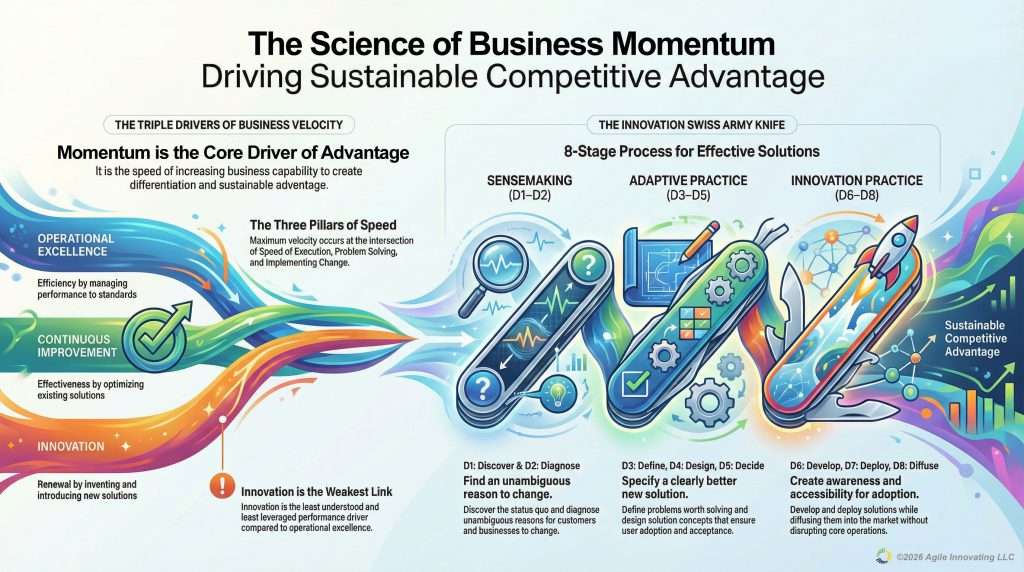
The Business Performance Acceleration Framework: Three speed pillars drive business velocity while the Innovation Swiss Army Knife provides a complete eight-stage process for systematic innovation from discovery to market diffusion.
A Complete Toolkit for the Entire Innovation Journey
The root issue isn’t that companies don’t have innovation processes. It’s that their processes are dangerously incomplete, leaving all three Speed Killers unaddressed. Traditional stage-gate approaches jump straight from ideation to development, skipping the diagnostic work that prevents Strategic Blindness, the capability building that prevents Inadequate Capability, and the systematic deployment that prevents Execution Breakdowns.
The Business Performance Acceleration Framework functions as a complete innovation toolkit. Like a Swiss Army knife, it provides the right instrument for every stage of the innovation journey, with each tool specifically designed to eliminate one of the three Speed Killers. The system ensures you accomplish three essential things every successful innovation achieves:
Diagnosing an unambiguous reason for change that eliminates Strategic Blindness by making the need for new solutions so clear, so obvious, that businesses and customers can’t ignore it. This prevents momentum loss from uncertainty.
Specifying a clearly better new solution that eliminates Inadequate Capability by matching solution complexity to problem complexity, ensuring you have the capabilities needed to deliver what you promise. This prevents momentum loss from risk.
Introducing that solution to market without execution breakdowns by systematically deploying solutions that achieve adoption without causing massive disruption to core business or creating unnecessary friction for early adopters. This prevents momentum loss from inability.
The Three-Practice Framework Architecture
The Business Performance Acceleration Framework structures innovation work around three core practices, each addressing a specific Speed Killer through systematic prevention of momentum losses.
The Sensing Practice: Preventing Strategic Blindness
Before you can build momentum effectively, you have to eliminate Strategic Blindness by making sense of the business landscape where problems exist. The Sensing practice focuses on discovering and diagnosing with two essential stages:
D1 – Discover the Current Situation examines the status quo to understand what’s happening now, what’s working, what’s breaking down, and what signals indicate change is coming or already underway. This builds the landscape intelligence that prevents uncertainty from paralyzing action.
D2 – Diagnose Circumstances-Worth-Changing identifies the specific situations where change creates value and determines which changes are worth making given the effort, risk, and opportunity cost involved. This creates the unambiguous reason for change that releases the first brake.
This practice eliminates Speed Killer #1 by building the clarity needed to act decisively. It’s the most neglected practice in traditional innovation processes — and the foundation everything else depends on. Sensemaking before invention is the differentiating entry point of the Business Performance Acceleration Framework.
Output: Strategic clarity about what needs to change, why, and when.
The Adapting Practice: Preventing Inadequate Capability
Once you’ve eliminated Strategic Blindness, the Adapting practice prevents Inadequate Capability by ensuring your solutions match the complexity of the problems you’ve diagnosed. This practice includes three progressive stages:
D3 – Define Jobs-To-Be-Done translates diagnosed circumstances into specific problems worth solving, framed from the perspective of what people are trying to accomplish and what’s preventing them from succeeding.
D4 – Design New Solution Concepts explores multiple approaches to solving those problems, generating concepts worth developing further through prototyping and testing that match your capability level.
D5 – Decide Solutions-Worth-Developing applies decision frameworks to determine which concepts justify full development investment based on feasibility, viability, and desirability aligned with your organizational capabilities.
This practice eliminates Speed Killer #2 by reducing the risk of committing to solutions you can’t deliver effectively. You build capabilities systematically rather than hoping execution overcomes inadequacy. Most organizations discover capability gaps during execution — too late and too expensive to address. The Adapting practice prevents that.
Output: Organizational capability matched to change complexity before execution begins.
The Innovating Practice: Preventing Execution Breakdowns
With Strategic Blindness eliminated and capabilities matched to complexity, the Innovating practice prevents Execution Breakdowns through three final stages:
D6 – Develop Solutions-To-Develop builds production-ready solutions using agile development methods that maintain momentum while managing technical and market risk through iterative delivery.
D7 – Deploy Solutions-To-Deploy introduces new solutions to market with launch strategies that create awareness and drive adoption among target customers without disrupting core operations.
D8 – Diffuse Solutions-Worth-Adopting accelerates market acceptance by reducing adoption friction and supporting customers through the behavior change required to switch from old solutions to new ones.
This practice eliminates Speed Killer #3 by ensuring execution quality matches opportunity size. Momentum builds because you’re executing effectively, not just executing quickly. This isn’t about adding more resources — it’s about systematically engaging the right resources at the right time.
Output: Rapid, reliable NPD implementation that hits market opportunity windows.
Integration: The Complete System
The three practices work together as a complete system:
→ Sensing identifies what to change
→ Adapting builds capability to change it
→ Innovating implements change effectively
When all three practices work together to neutralize their respective Speed Killers, gains accumulate instead of being destroyed by losses. Strategic clarity compounds. Capability compounds. Market advantages compound. This is how systematic prevention of losses enables Compounding Momentum — exponential performance acceleration that compounds over time.
Preventing Losses by Accelerating Action
The Business Performance Acceleration Framework prevents momentum losses and accelerates business performance improvement through systematic approaches to six critical business scenarios. Each scenario represents an opportunity to eliminate Speed Killers before they destroy momentum:
Eliminate losses you’re already incurring by diagnosing what’s going wrong (prevent Strategic Blindness) before problems compound into larger momentum drains.
Avoid probable losses from inaction by identifying performance drivers and signals of change in the business landscape (prevent Strategic Blindness) before competitors move first.
Prevent losses from wrong action by eliminating uncertainty about what to change, how much to change, and how fast to implement change (prevent Inadequate Capability).
Prevent losses from ineffective action by ensuring initiatives achieve the intended change (prevent Execution Breakdowns) rather than fizzling out before impact.
Minimize risks of potential losses by reducing the probable impact of change you can see coming (prevent Inadequate Capability) but can’t completely avoid.
Mitigate threats of future losses by anticipating what has the potential to change in consumer, solution, or enterprise environments (prevent Strategic Blindness) before those changes arrive.
Each scenario requires different tools from the framework toolkit, but all share the common goal of preventing momentum losses that make business performance improvement impossible.
Building Your Performance Improvement Engine
When you look at how your organization tries to create what’s next, do you have a complete toolkit for the entire innovation journey? Or are you trying to build the future with just execution tools while missing the Sensing and Adapting practices that determine whether you’re executing on the right things?
Sustainable business performance improvement requires systematically eliminating all three Speed Killers: Strategic Blindness that prevents momentum building, Inadequate Capability that prevents momentum sustaining, and Execution Breakdowns that cause momentum loss. The organizations that dominate their categories aren’t necessarily smarter or better funded. They’re better at preventing the losses that make acceleration impossible in the first place.
PDMA’s research spanning two decades confirms this pattern: best-practice firms achieve success rates approximately 40–50% higher than firms without structured innovation processes — not because they work harder, but because they prevent the losses that destroy momentum before gains can accumulate. (PDMA 2003 | PDMA 2021)
The Business Performance Acceleration Framework provides the systematic methodology for eliminating Speed Killers and building Compounding Momentum into your organization’s DNA. Not through heroic individual efforts or lucky market timing, but through repeatable Sensing, Adapting, and Innovating practices that prevent momentum losses at each stage of the innovation journey. That’s how you release the brakes, build unstoppable momentum, and win lap after lap in a race that never ends.
© 2026 Axiom™ LLC | Kevin Fee