
Understanding Innovation Dualities
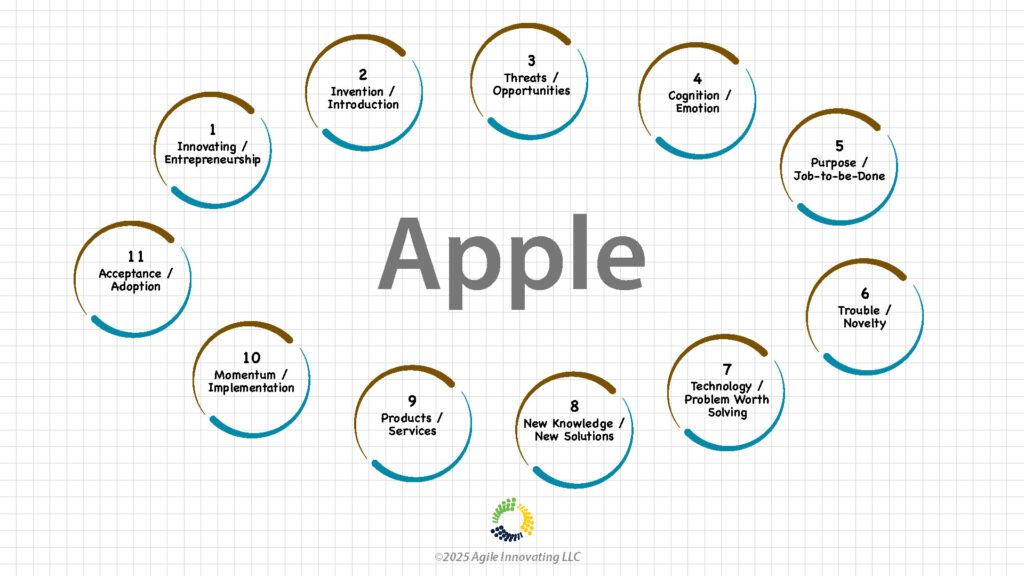
Innovation dualities represent the multi-dimensional, multi-factor reality of innovation success. Through decades of R&D and NPD management experience, I have identified 11 dimensions organized as two-factor variables that make the difference between a ripple and a splash in the marketplace. Successful sensemaking practices help organizations recognize these critical factors before they become obstacles to execution.
These two-factor variables are called “dualities.” Four of them are paradoxes where the factors have opposing effects requiring careful balancing. The other seven are mutually reinforcing where both factors work together. As Harvard Business Review research confirms, managing these tensions is essential for building truly innovative cultures. Here is a brief description of the innovation dualities in the Apple iPhone context.
The iPhone’s success wasn’t mastering one duality. It was managing all 11 simultaneously:
Innovation + Entrepreneurship: Revolutionary technology + systematic commercialization
Invention + Introduction: Design freedom + manufacturing discipline
Threat + Opportunity: Protected iPod while building future iPhone
Purpose + Job: Apple’s mission aligned with user needs
Cognitive + Emotional: Functional capability + delightful user experience
Trouble + Novelty: Solved real problems with a novel approach
Technology + Problem: Multi-touch capability met usability dissatisfaction
Knowledge + Application: Technical knowledge was applied across all criteria
Product + Service: Hardware and services co-designed
Momentum + Friction: Revolutionary change without organizational chaos
Acceptance + Adoption: Systematic progression from internal acceptance to external adoption
An Introduction to Innovation Success Dualities
Organizational execution determines whether individual innovations succeed. The 11 innovation dualities address the performance factors within a multi-dimensional business framework. McKinsey research on innovation essentials demonstrates that strategic and organizational factors separate successful innovators from the rest. Mastering the dualities increases innovation success rates from the typical 40% to 70% and greater.
Seven dualities are mutually supportive (meaning both factors work together). Four are paradoxical (the factors have opposing effects so a balancing is required).
This framework has yielded a critical insight behind successful innovations: Successful innovation requires managing all these dualities well, not just one or two. Organizations that deliver on at least 8 of the 11 dualities achieve sustained innovation success. Those that master only 2 or 3 see occasional wins but inconsistent results. This systematic approach to innovating practice transforms how organizations execute on innovation initiatives.
The Apple iPhone: Mastering All 11 Innovation Dualities
To illustrate how these 11 innovation dualities work together in practice, we’ll examine Apple’s iPhone development and launch (2004-2007). This project demonstrates what it looks like when an organization systematically addresses all the project-level dualities. Harvard Business Review’s research on how Apple is organized for innovation reveals the organizational design and leadership model that played a crucial role in their innovation success.
The iPhone’s success wasn’t just luck or genius. It was the disciplined management of interconnected factors that most organizations treat as separate problems. Successful innovation dualities management requires adaptive capability that matches organizational response to each duality’s unique complexity.
DUALITY 1: Innovating / Entrepreneurship
Type: Supportive duality
The Duality: The need to balance developing new solutions (Innovating) with commercializing them (Entrepreneurship).
Innovating focuses on creating attractiveness. Entrepreneurship focuses on facilitating adoption. Both capabilities must work together for market success.
How Apple Addressed This:
Innovating:
- Multi-touch interface technology development
- iOS operating system architecture
- Integration of phone, iPod, and other internet enabled devices
- Revolutionary user experience design
Entrepreneurship:
- Steve Jobs personally negotiated carrier partnerships
- Exclusive AT&T deal structured revenue sharing
- Retail store strategy for hands-on demonstrations
- Marketing campaign focused on customer experience
Result: Technology development paired with a systematic commercialization strategy. Apple didn’t just invent a better phone. They created an entirely new market structure.
Lesson: Organizations strong in one factor but not the other fail. Great technology without commercialization strategy dies in the lab. Great go-to-market planning without innovation delivers mediocrity.
DUALITY 2: Invention / Introduction Paradox
Type: Paradox duality ⚠️
The Paradox: Individual design skills drive invention productivity, while organizational process skills drive introduction productivity. These skill sets often conflict in project environments.
The common ground is a fully detailed new solution specification that bridges both worlds.
How Apple Addressed This:
Invention (Individual Design):
- Small core team with Steve Jobs’ direct involvement
- Rapid prototyping and iteration
- Designer freedom to explore radical concepts
- “Antennagate” tolerance for imperfection in pursuit of design
Introduction (Organizational Process):
- Manufacturing partnerships with Foxconn
- Supply chain for millions of units
- Quality control processes
- Launch logistics and carrier coordination
Result: Breakthrough design that could actually be manufactured at scale. The specification document was detailed enough for manufacturing but flexible enough to preserve innovation.
Lesson: The solution specification document is the foundation of everything. Make it detailed enough for processes yet flexible enough to preserve innovation. Apple’s specs were famously precise but protected design integrity.
DUALITY 3: Threat / Opportunity Paradox
Type: Paradox duality ⚠️
The Paradox: Organizations must simultaneously defend existing revenue streams (threats) while pursuing future opportunities that may cannibalize current business.
How Apple Addressed This:
Managing the Threat:
- Continued iPod development and sales
- Protected existing music player dominance
- Generated cash flow to fund iPhone development
Pursuing the Opportunity:
- Built iPhone knowing it would eventually cannibalize iPod
- Invested heavily in future platform
- Accepted near-term revenue risk for long-term market position
Result: Apple successfully transitioned from iPod dominance to iPhone dominance without losing momentum. They managed both simultaneously rather than choosing one.
Lesson: Most organizations choose between threat response OR opportunity pursuit. Winners do both simultaneously, even when future opportunities will cannibalize current success.
DUALITY 4: Purpose / Job-to-be-Done
Type: Supportive duality
The Duality: Align business purpose (what we intend to do and why) with the user desire for better solution experiences. This alignment motivates both the organization and the customer to embrace change.
How Apple Addressed This:
Apple’s Purpose:
- “Think Different” – challenging conventional technology design
- Making technology accessible through elegant simplicity
- Integration of hardware and software for seamless experience
User’s Job-to-be-Done:
- Stay connected without frustration
- Access internet on-the-go easily
- Consolidate multiple devices into one
- Enjoy using technology rather than tolerating it
Result: Perfect alignment between Apple’s purpose and user needs created conviction internally and adoption externally.
Lesson: When your business purpose and the users job-to-be-done align, you get conviction internally and adoption externally. Misalignment creates confusion and resistance on both sides.
DUALITY 5: Cognitive Response / Emotional Reaction
Type: Supportive duality
The Duality: Every solution triggers both cognitive evaluation (“Does it work better?”) and an emotional reaction (“Do I like it?”). Understanding both dimensions reveals problems worth solving.
How Apple Addressed This:
Cognitive (Functional):
- Better web browsing than competitors
- Superior battery life management
- Multi-touch precision for typing
- Visual voicemail efficiency
Emotional (Experiential):
- Beautiful design that felt premium
- Delightful interactions (pinch-to-zoom, smooth scrolling)
- Pride of ownership
- “Magical” experience marketing
Result: The iPhone delivered both functional superiority and emotional delight, creating unprecedented customer loyalty.
Lesson: Cognitive evaluation gets you in the consideration set, but emotion drives purchase decisions and loyalty. iPhone succeeded because it delivered on both dimensions better than the competitors products.
DUALITY 6: Trouble / Novelty Paradox
Type: Paradox duality ⚠️
The Paradox: Innovation requires both solving existing problems (reducing trouble) and creating genuinely new approaches (novelty). Too much focus on either dimension alone fails.
How Apple Addressed This:
Trouble Reduction:
- Eliminated stylus frustration
- Simplified email setup
- Solved mobile web browsing usability
- Fixed phone keyboard typing errors
Novelty Creation:
- Multi-touch interface (completely new)
- App Store ecosystem (revolutionary)
- Visual voicemail (novel approach)
- Integrated device concept (unprecedented)
Result: The iPhone reduced existing troubles through novel approaches rather than incremental improvements. This created category-defining success.
Lesson: Novelty without trouble reduction is a toy. Trouble reduction without novelty is an incremental change. The iPhone had both in balance, creating category-defining success.
DUALITY 7: Technologies / Problems Worth Solving
Type: Supportive duality
The Duality: Innovation requires both an enabling technology AND a problem worth solving.
How Apple Addressed This:
Technology Readiness:
- Capacitive touchscreen technology matured
- ARM processor performance reached threshold
- Battery technology enabled all-day use
- Wireless network speeds became viable
Problem Worth Solving:
- Smartphones too difficult to use
- Mobile web experience terrible
- Device proliferation (phone + iPod + PDA)
- Business/consumer divide needed bridging
Result: Technology maturity and problem urgency reached acceptance threshold simultaneously in 2007, creating perfect timing.
Lesson: Monitor technology readiness and problem urgency independently. Innovation opportunities emerge when both reach the acceptance threshold simultaneously. Timing matters enormously.
DUALITY 8: New Knowledge / New Solutions
Type: Supportive duality
The Duality: Innovation begins with new knowledge, but success requires applying that knowledge in desirable, feasible, viable, and compatible ways.
How Apple Addressed This:
New Knowledge:
- Multi-touch sensing research
- User interface psychology
- Mobile computing architecture
- Consumer behavior insights
Application Criteria:
- Desirable: Users wanted simpler smartphone experience
- Feasible: Technology could deliver the vision
- Viable: Business model supported development costs
- Compatible: Worked within carrier ecosystem
Result: Knowledge was applied across all four criteria, ensuring market success.
Lesson: Knowledge creates possibility. Application across all four criteria creates market success. Fail any one criterion, and innovation fails regardless of knowledge quality.
DUALITY 9: Product / Service Duality
Type: Supportive duality
The Duality: Products are distinguished by the services they perform; services are distinguished by the products they utilize. This bidirectional relationship shapes solution design.
How Apple Addressed This:
Product Perspective (Phone as Hardware):
- Multi-touch screen
- Accelerometer
- High-quality camera
- Premium build quality
Service Perspective (Services Delivered):
- iTunes Store
- App Store ecosystem
- Visual voicemail
- Seamless sync with Mac
Result: Hardware and services were co-designed from the start. Neither made sense without the other, creating powerful ecosystem lock-in.
Lesson: Don’t design products then add services later, or vice versa. Co-design them from the beginning to create integrated value.
DUALITY 10: Momentum / Friction Paradox
Type: Paradox duality ⚠️
The Paradox: Rate-of-change depends on the momentum-to-friction ratio.
Too little momentum and friction prevents change. Too much momentum causes chaos which suppresses change. Optimal change happens in the balanced middle zone.
How Apple Addressed This:
Creating Momentum:
- Clear vision from Jobs
- Dedicated team
- Aggressive timeline
- Market launch deadline
Managing Friction:
- Prototype iterations managed expectations
- Phased feature development
- Manufacturing partner learning curve
- Internal testing and refinement
Result: Revolutionary change executed without organizational chaos. Fast enough to beat competitors, controlled enough to maintain quality.
Lesson: Balance momentum and friction. Too much momentum creates chaos. Too little means competitors move first. Find the productive middle zone.
DUALITY 11: Acceptance / Adoption
Type: Supportive duality
The Duality: Organizations must accept new solutions internally before customers can adopt them externally.
Acceptance is the bottleneck that gates adoption. Without acceptance, solutions never become available. Without adoption, there’s no demand to sustain availability of the new solution.
How Apple Addressed This:
Internal Acceptance (Within Apple):
- Executive team alignment
- Resource allocation
- Manufacturing commitment
- Retail store preparation
External Adoption (Market):
- Strategic AT&T partnership
- Developer ecosystem building
- Early adopter targeting
- Systematic market expansion
Result: Internal acceptance was secured before external launch, ensuring organizational readiness when market demand surged.
Lesson: Sequence matters. Get internal acceptance first, then drive external adoption. Trying to force adoption before acceptance creates organizational failure.
Comparing Success and Failure Through Innovation Dualities
To demonstrate the framework’s diagnostic power, let’s examine why competitors failed using the same innovation dualities lens. MIT Sloan Management Review research on digital transformation shows that companies must cultivate both digital capability and leadership capability—a principle that applies equally to managing innovation dualities systematically.
Microsoft Zune
Strengths:
- ✅ Technology + Problem (technically capable)
- ✅ Knowledge + Application (technically capable)
Weaknesses:
- ❌ Momentum + Friction (too late, too slow)
- ❌ Acceptance + Adoption (carriers and developers were never fully committed)
- ❌ Purpose + Job (unclear value proposition)
- ❌ Product + Service (services weren’t integrated)
Result: Failed despite technical competence
Google Glass
Strengths:
- ✅ Technology + Problem definition (advanced tech)
- ✅ Novelty (extremely novel)
Weaknesses:
- ❌ Trouble (didn’t reduce enough existing trouble to justify the cost)
- ❌ Cognitive + Emotional (privacy concerns overwhelmed benefits)
- ❌ Acceptance (social acceptance never achieved)
- ❌ Purpose + Job (solution looking for problem)
Result: Failed despite innovation
BlackBerry (Response to iPhone)
Strengths:
- ✅ Acceptance (enterprises loved them)
- ✅ Current Adoption (10M+ users)
Weaknesses:
- ❌ Purpose + Job (missed the shift from enterprise to consumer job)
- ❌ Threat + Opportunity (defended existing vs. building new)
- ❌ Momentum + Friction (organizational inertia too strong)
- ❌ Cognitive + Emotional (functional but not delightful)
Result: Failed to respond despite initially dominant market position
Project Execution Summary
These 11 innovation dualities determine whether individual innovation initiatives succeed or fail. Organizations that master 8+ innovation dualities see results that align with McKinsey’s research on innovation execution:
- 70%+ project success rates (vs. 40% industry average)
- Faster time-to-market
- Higher adoption rates
- Greater market impact
- Sustained competitive advantage
You need to deliver on at least 8 of the 11 innovation dualities, not just 2 or 3. Occasional success comes from getting lucky on a few factors. Sustained success comes from systematic management of multiple innovation dualities simultaneously. The Innovation Dualities Framework provides organizations with a diagnostic tool to assess their current capability and identify specific areas requiring improvement.
The iPhone succeeded because Apple managed all 11 dualities well. Competitors failed because they mastered 2 or 3 at most.
© 2026 Axiom™ LLC | Kevin Fee