
The Innovation Paradox Most Leaders Miss
Most business leaders ignore early signals of change. They focus on what’s working, celebrate successes, and maintain operations delivering consistent results. Signals that existing solutions are failing to meet evolving needs get dismissed as execution or customer problems — things to fix, not strategic indicators to recognize.
This instinct is exactly backward for innovation.
Signals of change emerge wherever existing solutions create friction. Every friction point reveals where current solutions fail to fully meet customer needs. Organizations that systematically recognize these signals discover where change is most urgently needed before competitors or market forces make change unavoidable. Those that ignore them miss these opportunities until a crisis forces reactive response.
The pattern is consistent: Organizations that recognize signals proactively create change on their terms. Organizations that ignore signals react to change on someone else’s terms.
What Change Signals Actually Reveal
The world contains existing solutions for everything people want to accomplish — making calls, processing payments, traveling between cities, managing projects, analyzing data. As Clayton Christensen’s Jobs-to-be-Done frameworkdescribes, every job has available solutions.
But no solution is perfect. Each embodies some form of inadequacy that users must manage, tolerate, or work around. These inadequacies aren’t optional — they’re inherent in the solution’s design, implementation, or context.
Organizations typically treat inadequacies as execution problems requiring operational fixes: better training, process improvements, enhanced quality control. These responses assume the underlying solution is sound and inadequacies reflect implementation gaps.
This assumption misses the actual significance. Inadequacies signal that change is needed in the solution itself, not just its execution.
The Two Dimensions of Signals of Change
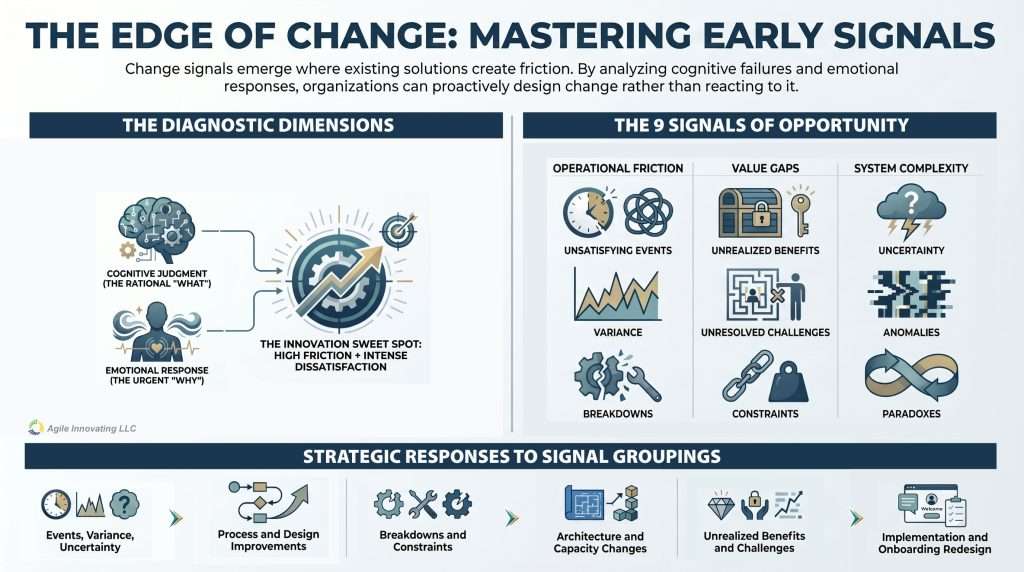
Signals of change manifest in two interconnected dimensions that together indicate whether change is worth pursuing.
Cognitive Judgment
The rational assessment of solution performance, ranging from “This is more difficult than necessary” to “This doesn’t work at all.” This dimension identifies specific problems: excessive complexity, unreliable performance, missing capabilities, poor integration, inadequate results. Cognitive judgment tells you what is wrong.
Emotional Response
The felt experience of using the solution, ranging from “I’ll deal with it” to “I must do something different.” This dimension indicates urgency and willingness to change:
- Mild frustration — users tolerate inadequacy
- Significant annoyance — users seek workarounds
- Intense dissatisfaction — users demand alternatives
Emotional response tells you whether inadequacy matters enough to justify change.
Both dimensions are required. Cognitive judgment without emotional response identifies problems no one cares about solving. Emotional response without cognitive judgment creates urgency without direction.
Real-World Example: Zoom (2013–2020)
By 2013, when Zoom launched, video conferencing solutions had been generating substantial cognitive signals of change for years: complex setup, unreliable connections, poor quality, confusing interfaces. For years, users tolerated these inadequacies because the emotional response was manageable. Video calls were occasional events where difficulty seemed unavoidable.
COVID-19 transformed emotional response. Suddenly video calls became a daily necessity. Inadequacies that were tolerable occasionally became unbearable constantly. The emotional response shifted from “I’ll deal with it” to “This must work better.”
Zoom succeeded because they recognized both dimensions early — designing for zero-friction experience (cognitive) that would matter intensely when video became essential (emotional). The cognitive-emotional combination predicted the change that eventually occurred.
The 9 Types of Signals of Change
Understanding different signal types helps you recognize change signals independent of emotional intensity. Each type points toward specific kinds of solutions.
Type 1: Unsatisfying Events Using a solution involves doing something difficult — either complicated (hard to do) or complex (hard to understand). Example: Traditional expense reporting requires collecting receipts, categorizing expenses, matching to purchase orders, submitting forms, and tracking approvals. Complicated by many steps, not conceptually complex. Change indicated: Simplify workflows, reduce steps, automate repetitive actions.
Type 2: Excessive Variance Solution delivers inconsistent experiences — sometimes works, sometimes doesn’t, or always delivers the same experience but different than expected. Example: Hotel check-in times that vary wildly from the posted 2:00 PM time. Users can’t plan reliably. Change indicated: Standardize processes, improve predictability, set accurate expectations.
Type 3: Breakdown Solution simply doesn’t work when needed. Example: Mobile banking apps that fail during market volatility — precisely when users most need to act. Change indicated: Improve reliability, add redundancy, redesign architecture.
Type 4: Too Much Uncertainty Solution rarely provides the same experience twice — outcomes are unpredictable. Example: Early voice assistants (circa 2014) with inconsistent comprehension. Users couldn’t learn what worked because responses were random. Change indicated: Reduce randomness, improve consistency, provide feedback on what works.
Type 5: Unrealized Benefits Solution promises benefits it doesn’t actually deliver. Example: Enterprise software promising “actionable insights” that requires extensive data cleaning and specialized training before generating useful reports. Change indicated: Lower barriers to value, align promises with reality, accelerate time-to-benefit.
Type 6: Unresolved Challenges Realizing solution benefits requires performing additional unspecified activities. Example: Smart home devices requiring network configuration, app downloads, account creation, and device pairing before basic functionality works. Change indicated: Reduce prerequisites, simplify onboarding, automate setup.
Type 7: Constraints An unspecified factor limits the user experience. Example: Cloud storage services with “unlimited” plans that throttle speeds after certain thresholds or restrict file types. Change indicated: Remove constraints, disclose limitations upfront, redesign around bottlenecks.
Type 8: Anomalies Something unusual or unexpected occurs when using the solution. Example: Calendar apps that handle timezone changes inconsistently — sometimes adjusting meeting times correctly, sometimes creating duplicate entries, sometimes failing to sync. Change indicated: Handle edge cases, improve error handling, test unusual scenarios.
Type 9: Paradoxes How to improve the user experience is difficult to understand because it involves opposing factors. Example: Security measures that protect users by adding authentication steps also create difficulty by slowing access. More security means more friction. Change indicated: Manage tradeoffs explicitly, find non-obvious middle ground, accept that perfection in one dimension creates difficulty in another.
Why Signal Type Matters for Change Design
Identifying signal type accelerates problem definition and solution design. Different signals require different responses:
- Unsatisfying events, variance, and uncertainty → process and design improvements
- Breakdowns and constraints → architecture and capacity changes
- Unrealized benefits and unresolved challenges → implementation and onboarding redesign
- Anomalies → edge case handling and testing expansion
- Paradoxes → balanced solutions rather than optimization
Organizations that recognize signal types quickly separate probable solutions from the universe of possible solutions. They don’t waste effort on irrelevant approaches.
The Competitive Advantage of Systematic Signal Recognition
Most organizations wait for signals of change to become undeniable before responding — customer complaints, market share loss, competitive disruption. This reactive approach means change happens on someone else’s timeline.
Organizations that systematically recognize signals gain three advantages.
Early Signal Detection. Signals emerge gradually before becoming a crisis. Early detection enables proactive response while multiple solutions are still feasible. Netflix recognized DVD-by-mail limitations years before streaming became viable. They invested in streaming technology while the DVD business remained profitable. When streaming matured, Netflix was ready. Blockbuster waited until limitations became a crisis — too late to respond effectively.
Change on Your Terms. When you identify signals before competitors, you design the change rather than reacting to changes designed by others. Apple identified smartphone inadequacies (difficult interfaces, limited functionality, carrier control) and designed the iPhone to cause specific changes in those areas. Competitors spent years responding to changes Apple designed rather than changes they chose.
Resource Allocation Clarity. Signals indicate where investment matters most. Resources flow toward problems worth solving rather than dispersing across everything. Amazon identified checkout difficulty (abandoned carts from repetitive form entry) and created 1-Click ordering — addressing the specific inadequacy that prevented purchases. Competitors added features randomly while Amazon focused on the friction that mattered.
Identifying which signals your organization is missing starts with understanding which Speed Killers are active. Take the Speed Killer Assessment →
How to Systematically Recognize Signals
Organizations that excel at finding signals of change use three practices.
Direct Observation. Watch users actually using your solution in context. Don’t rely on surveys or reports. Observe where they struggle, pause, improvise workarounds, or express frustration. Most organizations observe their solutions in ideal conditions — demos, controlled environments, expert users. Real signals appear in actual use by typical users in typical contexts.
Longitudinal Tracking. Signals often emerge over time through accumulated frustration rather than immediate crisis. Track experiences across multiple interactions, not just single events. What’s tolerable once becomes intolerable repeatedly. What seems minor individually becomes significant in aggregate.
Emotional Response Validation. Cognitive identification of signals isn’t sufficient. Validate that users actually care enough to change behavior. Many problems that seem significant cognitively generate no emotional response. Users note the issue but don’t actually seek alternatives. These signals reveal complaints, not opportunities.
Three Mistakes to Avoid
Confusing signals with complaints. Not every complaint represents a signal worth addressing. Some complaints reflect personal preferences or minority use cases. Signals worth acting on affect enough users with sufficient intensity to justify change investment.
Recognizing signals only when struggling. Organizations scan for signals when performance disappoints but ignore them when succeeding. This timing guarantees you’re always behind. Recognizing signals during success enables proactive change while resources and confidence support innovation.
Looking only at your own solutions. The most valuable signals often exist in adjacent areas or entirely different contexts. Uber discovered signals in taxi services. Airbnb discovered signals in hotel experiences. Neither company operated in those industries initially. Expand signal recognition beyond your current domain.
Signals of Change as a Strategic Asset
The innovation paradox is that signals of change — the indicators most organizations ignore — provide the foundation for competitive advantage.
Signals reveal where change is needed. The specific type of signal indicates what kind of change is appropriate. The cognitive-emotional combination signals whether change matters enough to invest in.
Organizations that systematically recognize signals of change convert them into three assets: an early warning system for needed change before crisis forces reaction, an innovation roadmap showing where development efforts matter most, and competitive differentiation through solving inadequacies others ignore or tolerate.
This conversion process begins with recognizing signals as indicators of needed change rather than execution failures. It continues with understanding different signal types and their implications. It culminates with designed change based on signals that matter.
Organizations that embrace this principle don’t wait for change to become unavoidable. They recognize signals of change early, design specific changes in response, and create solutions that address inadequacies others haven’t yet acknowledged. The Sensing → Adapting → Innovating framework provides the systematic methodology for converting those signals into designed change.
That’s the competitive advantage systematic signal recognition provides — when you know where to look.
Series Navigation
Previous: Opening — Why Change Design Precedes Solution Development Next: Article 1B — Reading the Business Landscape
© 2026 Axiom™ LLC | Kevin Fee