
The Question Behind Running the Business vs Building the Business
Running the business vs building the business asks two different things of the same organization, and most organizations never fully resolve the tension between them.
Last time, I asked a question I didn’t answer.
When something goes wrong in your organization, and something always is, what determines the quality and speed of your response?
I’ve spent a long time with that question. Long enough to notice that almost every organization I’ve worked inside, across six industries now, answers it the same way.
They split the work in two.
Why Every Organization Splits Running the Business from Building It
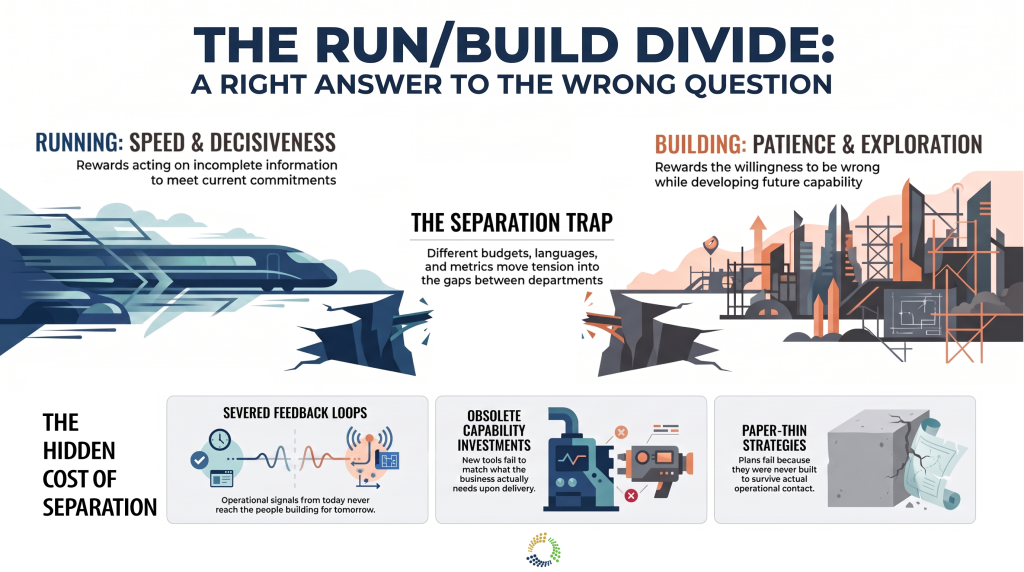
One half of the organization runs the business: keeps the commitments, serves the customers, solves the problems that show up today. The other half builds the business: develops what comes next, invests in the capability the organization doesn’t yet have. Different teams. Different budgets. Often different floors, different meetings, and different language for describing what “winning” looks like.
I want to be careful here, because it would be easy to describe this separation as a mistake. It isn’t. Running the business vs building the business is a genuine tension, not a failure of judgment.
Running the business and building the business genuinely ask different things of the people doing them. Running rewards speed, decisiveness, the ability to act on incomplete information because the moment won’t wait. Building rewards patience, exploration, the willingness to be wrong for a while before you’re right. Ask one person to be excellent at both, at the same time, under the same set of incentives, and you are asking for something that fights itself.
So organizations do the reasonable thing. They give each side its own home, its own leadership, its own success metrics. On paper, this looks like maturity: a business sophisticated enough to specialize.
The Hidden Cost of Separating Running the Business and Building It
Here is the part that took me longer to see than I’d like to admit.
The separation doesn’t resolve the tension between running and building. It just moves it: from inside one person’s job description to the space between two departments. And that space is exactly where the feedback loop was supposed to live: the connection between what the organization is learning by running the business today, and what it’s choosing to build for tomorrow.
Sever that connection, and three things start happening at once, quietly, long before anyone names them as related.
The organization keeps solving today’s problems without the signals from tomorrow ever reaching the people running the business for today. It keeps building capability that doesn’t match what running the business actually needs by the time it’s ready. And it keeps executing plans that were sound on paper but were never built to survive contact with how the organization actually operates.
None of this looks like one big failure. It looks like a dozen small ones: a launch that underperforms, a market shift that arrives as a surprise, a capability investment that’s obsolete before it pays off. Each one gets its own explanation. Nobody connects them, because the thing connecting them is the structure nobody’s questioning.
The Right Answer to the Wrong Question
I don’t think this makes anyone careless. I think it makes them reasonable.
Separation was the right answer to a real question: how do we support running the business vs building the business, two very different kinds of work, so that each can be done well? It’s just the wrong question to be solving for, because the two kinds of work were never supposed to be separate in the first place. They were supposed to be in constant conversation, one informing the other, continuously, not on paper, but in fact.
Separation is the right answer to the wrong question.
I keep coming back to that sentence because I think it’s the most honest way to describe what I’ve watched happen inside organization after organization, including some I built myself, before I understood what I was looking at.
If that’s the actual structure underneath the losses (not bad people, not bad intentions, but a good answer to the wrong question) then the next question is the one worth sitting with.
What, specifically, does that separation cost? Not in general. Specifically. Mechanically. In ways you could point to.
There are three costs. I’ll walk through them next time.
Until then.
Kevin
Previously in this series: Every Business Is in the Problem-Solving Business — Edition 1.
© 2026. All rights reserved.